What is the most universal and useful management tool of all?

What is the most universal and useful management tool of all?

Easy question. ‘5 whys’.

5 Whys was first articulated by Toyota’s architect of the TPS, Taiichi Ohno in the 50’s, but it was not new.

Anyone who has had children has been on the receiving end of a form of the ‘5 whys’ from about two and a half years old, to 6 or 7, by which time they have learnt  that the question is not always appreciated or answered fully, so they stop asking.

The process is deceptively  simple, keep asking ‘Why’ until you get to the root cause of the problem, well past the symptoms, so it can be fixed, and the problem not recur.

In a previous life managing a manufacturing business, we had a recurring problem with an automatic box erector that seemed intractable despite huge efforts. The whole line stopped every time the erector spat the dummy, causing serious production losses.

While it took months to find the right cause, after chasing a lot of rabbits down holes, we finally nailed it using 5 why.

  1. Why did the erector jam?

One of the arms was out of alignment to the flat box

  1. Why was the arm out of alignment?

One of the flat box ends was slightly crooked

  1. Why was the box end crooked?

The box end was slightly out of specification

  1. Why was the box end out of specification?

The purchasing manager had changed suppliers for a significant saving, and the new suppliers actual operational control allowed variations outside the erectors demanding requirements,  resulting in an occasional  mechanised  ‘dummy-spit’.

This example in fact only took us ‘4 whys,’ but the trick was to ask the right questions  in the first place, in the right sequence. This took us several months and cost a huge amount in lost production, and maintenance resources as we eliminated possible causes of the problem before anyone thought to examine if a 1 mm variation outside the spec of the flat box size was significant.

Once identified that it was, the problem was quickly fixed by moving back to the previous supplier with whom we had encountered  no problems.

Subsequently, we evolved a process that used 5 whys as a matter of course in search of improvements in the factory, and later, admin processes, and found that our problem resolution times dropped dramatically.

The process is pretty simple, just challenging to implement:

  • Institute a ‘5 whys’ meeting in response to a problem.
  • Invite (read insist) everyone involved and/or affected by the problem to attend the meeting.
  • Agree a ‘chairman’ for the problem who will take overall responsibility.
  • Proceed to ask ‘Why’ until you get to the root cause of the issue. It almost never takes more than 5 ‘whys’ hence the name. This step can take time and often takes several meetings as possible answers to the ‘why’ are considered.
  • Assign responsibility to install, test and validate the solution
  • Document and disseminate the solution which has been broken into a written process to ensure compliance, or easier further investigation should a similar problem arise.

The whole objective is to get to the root cause of  the problem, a process that is applicable not just in industry, but in your life, when you think about it.


Diagram courtesy Mindtools.com

How do you solve a critical problem?

How do you solve a critical problem?

Define the problem first!

Dealing with problems effectively requires that  you first define the problem. This sounds pretty obvious, so obvious in fact that many do not think about it, they just persist with workarounds that address the symptoms, without getting to the core of the problem to solve it.

Not all problems are the same, so logically, they will not all have the same solution.

Classifying them in some way is a good first step, so here are four suggestions.

The ‘Cock-up’ Box.

Something or someone has acted in a way that is inconsistent with normal. There has been a cock-up. It could be a machine broke down unexpectedly, a customer delivery does not arrive, or a key component of a marketing program is missing, and many others. Point is, it is abnormal, so go looking for the root cause of the abnormality. ‘5 Why’ normally works very well in these circumstances.

The ‘Poor Process’ box.

The outcomes of a process done regularly seems to vary each time it is done, there is no reliable standard. The level of reliability is such that someone has to check or rework what has been done. I had a client whose MD routinely checked the detail of quotes done by his staff, looking for the errors he knew they were making, which he corrected, without taking any further action. Unless the process that enables errors of this type to be made is addressed, the problems will persist. Mapping what happens always helps to identify the ‘holes’. In this case, I ‘attached’ myself to a couple of quotes from the point they were initially received, mapping  the action taken, by whom, when, and what was the trigger, and created a ‘map’ of the process. It was then obvious to all where the causes of the variations occurred, and steps were taken to remove them. The result was a much greater level of confidence in the accuracy of the quotation process, which freed up a significant chunk of the MD’s  time to do more useful things.

The ‘Get Better’ box.

This often looks like the one above, but the motivation is different, it is often the result of an external pressure, resulting in a previously acceptable level of performance no  longer being acceptable. The typical examples are cycle times of all sorts of things being shortened, from order to delivery time, design time, response time, to improving the quality, however that is defined. In Australia, the example on everyone’s mind is the management of power. Costs have gone through the roof, and suddenly shaving a percent off the power bills here and there becomes an item of considerable priority, so effort is going into tracking and addressing all points of power consumption that can be modified to cost less, or be eliminated.

The ‘Out of the Box’ box.

As the name implies, this is where the ideas to address the emerging challenges are addressed. These are  innovations that you can either implement yourself, or responses to the trends observed that require big change. Having an established process to deal with and leverage innovation, significant improvements, unexpected situations, and opportunities that become apparent, is challenging. What it requires is a continuous focus on strategy and the long term vision, mission, purpose, whatever terms you use in your business. These things are way too easy to stick in the ‘too hard basket’ or the ‘will do it tomorrow’ basket, in the knowledge that tomorrow never comes without another short term crisis to address.

When you need assistance defining, then categorising the problems you face before developing solutions, give me a call.


A marketers rant about ‘content porn’

A marketers rant about ‘content porn’

Content has become a marketing buzzword delivering a tsunami of crap into our inboxes, cluttering up our phones, and potentially delivering all sorts of nasty surprises if we open them.

Content started as a great idea, suddenly we could communicate directly with those in our markets and give them stuff of value, that coincidentally led to a transaction, perhaps many transactions.

Anyone would think this was new, this is what advertising has done for decades, we can now just target the recipient more accurately.

We have forgotten the ultimate objective of content is to create circumstances where a transaction can occur. However, ‘Content’ has become a cliché, and we all indulge, churning out shit that does nobody any good.

It is like Porn, interesting at first, perhaps educational for some, offensive to others, but quickly becoming just boring.

People are keen to receive things of value, things that make a difference to their lives, but increasingly the stuff they are being delivered is just content porn, doing nobody any good, leading to the turn off, so that the good stuff gets missed in the never ending churn.

There is a branding opportunity here, send only good stuff, and personalise it!

What we need to produce is ideas, not indulgence, and there is way too little of the former and too much of the latter.

Let’s be fair dinkum about what content is.

Fair chance it is a regurgitated version of something else, and by the time the first good idea has been reshaped, and re-imagined, it has become blurred and unrecognisable. An original good idea is something most recognise when they see it, simply because it demands attention and action.

That is what  we need, more ideas, originality, and deviance, in a nice way, that demands your attention, and drives an action. We do not need more of the same old content porn.

I read somewhere, and I wish I could take credit for it that: ‘if I take a photo of a pile of dog shit, I have a photo of a pile of dog shit, if I upload it to  a website, it becomes content’

Sounds a bit like the inimitable Bob Hoffman, but could not locate the source.


Jack is back!!

Jack is back!!


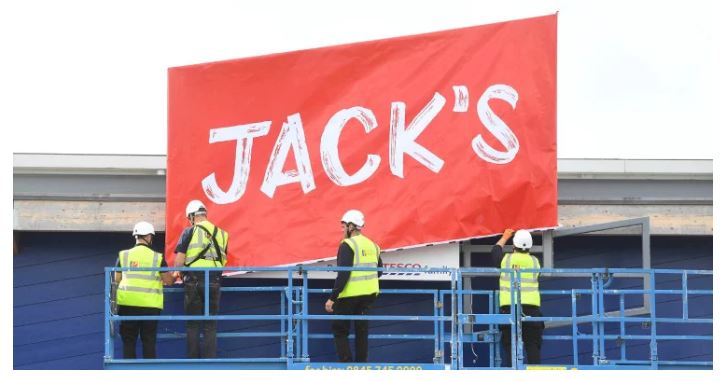
Tesco in the UK is in the launch phase of a discount chain, ‘Jacks’ as a competitive response to the inroads of German discounters Aldi and Lidl.

I can only assume Coles and Woolies management are watching with interest, as they have yet to find a way to combat Aldi in their backyard, and in the absence of a better idea might just copy it, almost as something to do.

Second ranked Sainsbury’s strategy has been different. They are ‘merging’ with Wal-Marts Asda chain in a deal reported to be  worth 7.3 billion pounds. This deal would take them past Tesco as the UK’s biggest retailer, and so needs regulatory approval. Wal-Mart bought Asda in 1999, believing their discount model that made them the biggest retailer in the world by a country mile, would work in the UK. They have clearly failed in the face of more effective discounters from Germany. Meanwhile, both Aldi and Lidl are rummaging around in Wal-Marts US backyard.

Perhaps Wal Mart have recognised the threat to their dominance is coming from more than Amazon and are hunkering down for a fight?

As this all unfolds, I suspect history will reveal that Tesco has made a huge blue.

They are setting out to make Jacks clearly part of the ‘Tesco family’ according to the blurb sprouted by CEO David Lewis at the opening of the first Jacks, just down the road from an Aldi site. At the same time, they are committed to sourcing ‘British first’.  This is a mix of business models that must make the Aldi executives giggle with joy, as all it will do is drain money from the Tesco coffers while highlighting Aldi’s positioning as the cheapest around. Setting out to ‘out-Aldi’ Aldi will be a doomed strategy, particularly as they have already compromised it by being overtly British first. This approach may appeal to some, but those who shop at Aldi do so for the price, first, second and last, and will not care about ‘Britishness’, so all Tesco will be doing is damaging their own positioning, and dropping bundles of cash.

From a distance, I hope those few in Coles and Woolies who have been around for a while will whisper some common sense into the ears of their bosses.

Anyone remember Jack the slasher, Franklins, Bi-Low, and Jewel’ ?

All discounters, all now gone.

How much should I spend on that winning that tender?

How much should I spend on that winning that tender?


That is a common question, which requires some rephrasing to be answered with anything other than ‘It depends’

‘How much should I invest to increase my chances of winning that tender’ is a better question.

Would you spend 20k to have a 50/50 chance of a $5 million contract?

How about if your chances of success were only 20%. Would you still spend the 20k?

There is a continuum here, one that should change with your circumstances, and your judgement of your chances in the tender process. The management challenge is quantifying the level of risk tolerance that exists at that time.

‘How much should I spend’ is a form of question that implies a short term is involved, ‘How much should I invest’ implies a longer term. It may only be a semantic difference, but  there is a great difference in the manner in which you approach the tenders preparation.

Quoting on tenders has two elements, the first is that now it is a tender, the implication is always that you are just one of several to tender, so it is an auction, of sorts.

The second is that there is never a sure fire thing, even when you have the inside running for any one of a large number of reasons, the most usual being incumbency of some sort. The fact that there has been a tender made public is an indication that the tenderer is not only looking for a price, they are looking for ideas.

To some questions you should be asking yourself:

  • How valuable is the tender to me? If the tenderer is your biggest customer, and you are an incumbent for this sort of job, the answer would probably be very valuable, not just for the job being tendered, but for the ongoing relationship and flow of further work.
  • What is the strategic value of the customer? This will often be a similar answer to the previous question, but your largest customers always started as a new, much smaller customer, and grew, so considering how ‘strategic’ they may be is important. An acquaintance of mine has what he calls a ‘green-keeping’ business that specialises in public spaces. He will do everything possible to win tenders put out by public bodies, councils, schools, and the like, as each one he wins is strategically important not just to the current cash flow, but to the position he holds in the competitive field.
  • How unique is my solution? When you can do something none of your tender competitors can do, price becomes less important. Following the above example of the green-keeping business, he owns a tractor towed machine that ‘cores’ a surface, an important factor for vigorous grass growth on areas like football fields. All of his competitors need to hire such a machine (sometimes from him) as the need arises which adds a significant cost to maintenance and a resulting reluctance, which often enables him to get a superior outcome.
  • How close is the strategic fit of the tenderer to the profile of my ideal customer? Every successful business has an idea of what their ideal customers look like, and the closer to the ideal profile a tenderer is, the more important it will be to win a tender that arises from them.
  • How does the job fit into the existing workflow? When you have a ‘hole’ in your work flow, filling it becomes more urgent, the alternative being to cover the overhead costs from reserves or remove them. When the latter course is taken, it can be hard to resource back up when the work flows in again.
  • How does the job fit my capability mix? A key part of having a profile of the ideal customer is that the mix of capabilities you can deliver exactly matches what is required by the tenderer. Having to buy in a capability you do not have is a strategic decision, and should be made carefully.
  • What is the net cash flow from the project over the life of the project? To do any sort of financial calculation, this forecast is an absolute necessity. It should be done in any case, as you are bidding for the contract, and therefore should have calculated your costs and the financial benefits and risks. This is all that is needed for a financial calculation.


Having determined how important the job may be to win, the task is to increase your chances and decide how much to invest in winning.

There are two variables, the amount you invest, and the chances of winning the tender. To do a financial calculation on the options, you could use a function called  ‘Net Present Value’  or NPV. We all recognise that a dollar today is worth more than a projected dollar tomorrow. The value of tomorrows dollar being reduced by  the amount of inflation, and the certainty of the projected cash flow from the project.

To do an NPV calculation, you need to have projected the cash flows to which you are applying the formula.

The NPV formula is simple in principal: Assume an amount of $20,000 is outlaid with the projection that in the following 3 years the project will deliver 100k/year positive cash flow in current dollars, and the discount rate is 5% to allow for 5% inflation.

The cash flow looks like:

$20,000 initial investment, followed by year 1 net cash flow of $100,000, plus year2  100,000 X .95 = $95,000 plus discounted year 3 of $90,250.

The net cash flow from the project is therefore $285,250.

Therefore the net present value of the initial investment at the end of the project is $285,525 – $20,000, or $265,525. In this case, it would seem that the investment of 20k in winning the tender would be a very good investment indeed.

The discount rate can be changed to reflect not just the future value of current dollars, but to also  reflect the risk of not winning. This can be a more complex calculation, but relatively easily done with a formula called Internal Rate of Return (IRR) available in every spreadsheet package.

These two calculations, NPV and IRR are routinely done in tandem by accountants to calculate a risk adjusted return from an investment.

When considering the question ‘how much should I spend on this tender‘ they will together be very handy tools.

Cartoon credit: Scott Adams and Dilbert.